Cart

Tag

ingrown toenail treatment Archives - Bucks Foot Clinic

ingrown toenail treatment

Ingrown Toenail Treatment: Why DIY Makes It Worse

By Blog No Comments

Your Ingrown Toenail Is Not “Just a Bad Nail” When DIY Goes Wrong

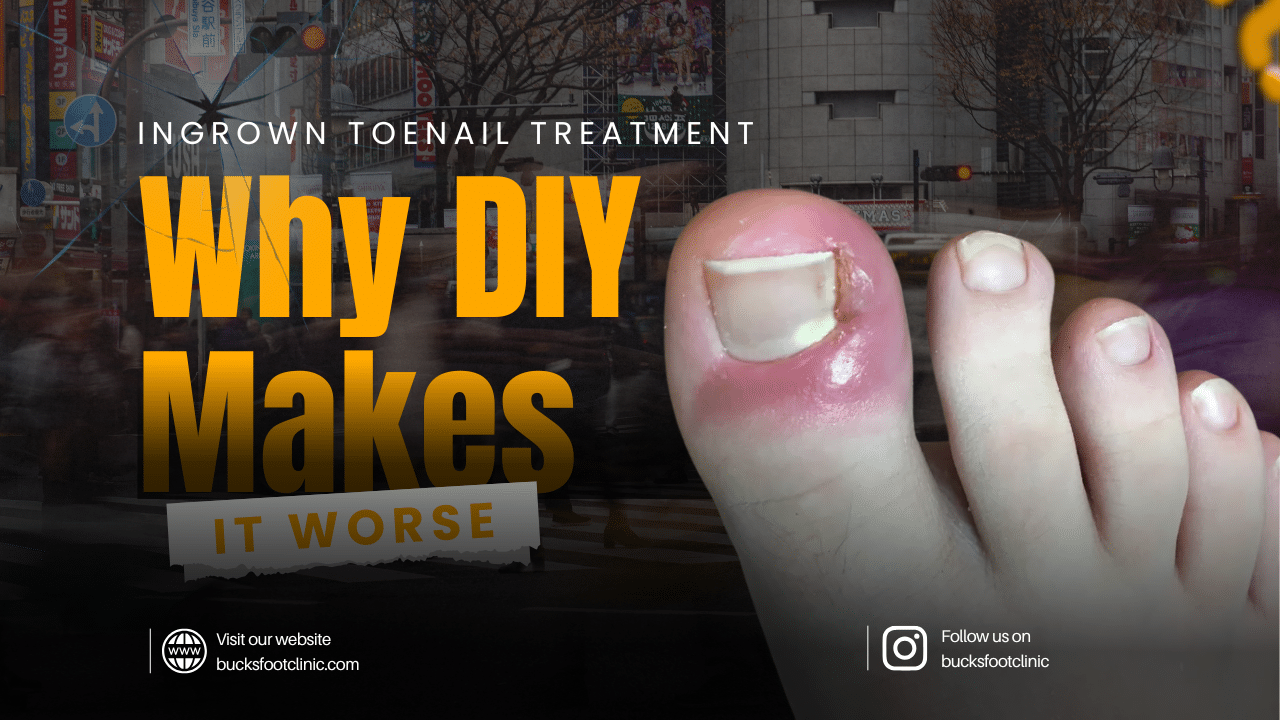
It starts with a niggle. A bit of tenderness along the side of your big toe. You think it’ll sort itself out, so you leave it. A few days later, it’s red, swollen, and throbbing. You grab the nail clippers and try to dig out the offending edge yourself in the bathroom, and that’s where the real trouble begins. Ingrown toenail treatment is one of the most common reasons people visit Bucks Foot Clinic, and in the majority of cases, patients come to us after DIY attempts have turned a minor problem into a painful, infected mess.

This isn’t a criticism. It’s completely natural to try to sort it yourself first. But understanding why home treatment so often makes things worse can save you weeks of unnecessary pain.

What Causes Ingrown Toenails?

An ingrown toenail occurs when the edge or corner of a toenail grows into the surrounding skin, causing pain, swelling, and sometimes infection. The big toe is most commonly affected, though any toenail can become ingrown.

Several factors contribute to ingrown toenails developing. Cutting nails too short or rounding the corners encourages the nail to grow into the skin as it regrows. Tight or narrow footwear presses the toes together, forcing the nail edge into the flesh. Trauma to the toe, such as stubbing it, dropping something on it, or repetitive pressure from sports, can alter nail growth. Some people are simply genetically predisposed to curved nails that are more likely to become ingrown. Sweaty feet soften the skin around the nail, making it easier for the nail edge to penetrate. Pedicures performed incorrectly (cutting too short, rounding corners, aggressive cuticle work) are another common cause.

Don't suffer from foot pain any longer

Book your appointment with Bucks Foot Clinic

Book Appointment

Why DIY Treatment Usually Makes It Worse

When you try to cut out an ingrown toenail at home, several things typically go wrong. First, you can’t see what you’re doing clearly enough the affected area is swollen, tender, and difficult to access. Second, bathroom nail clippers aren’t designed for precision work on an embedded nail edge. Third, and most importantly, you almost always leave behind a small spike or spicule of nail that you can’t see or feel at the time.

This tiny remnant continues growing into the skin, now in a deeper, more problematic position than before. The wound you’ve created from your DIY attempt also provides an open door for bacteria, leading to infection. What started as mild discomfort becomes a red, swollen, pus-filled toe that’s significantly more painful and more complicated to treat than the original ingrown nail.

Cotton wool wedged under the nail, repeated soaking, and antiseptic cream can help manage symptoms temporarily, but none of these address the underlying problem: a nail edge that’s growing where it shouldn’t be.

 Struggling with this problem? Call Bucks Foot Clinic on 01494 434366 or book online at bucksfootclinic.com for expert advice and treatment.

How to Prevent Ingrown Toenails

  • Cut your toenails straight across, never curved or rounded at the corners this is the single most effective prevention measure
  • Don’t cut nails too short; leave them level with the tip of the toe (approximately 1–2mm of white nail visible)
  • Use proper nail clippers or nippers designed for toenails, not small fingernail scissors
  • Wear shoes with adequate room in the toe box your toes should never feel squeezed or compressed
  • Keep feet clean and dry to prevent the surrounding skin from softening excessively
  • If you have pedicures, ensure the technician cuts nails straight across and doesn’t round the corners
  • Protect your toes during sport with appropriate footwear runners and footballers are particularly prone
  • If you notice early signs of an ingrown nail (tenderness, slight redness), don’t ignore it early professional intervention is simpler and less painful than treating an established infection

Why a Podiatrist Gets Better Results Than Home Ingrown Toenail Treatment

A podiatrist has the training, tools, and clinical environment to resolve ingrown toenails safely and effectively. Here’s what makes professional treatment fundamentally different from DIY:

  • We can see the full extent of the problem using proper lighting and magnification, identifying embedded nail spicules that are invisible to the naked eye
  • Sterile instruments designed specifically for nail work allow precise removal of the offending nail edge without damaging surrounding tissue
  • If infection is present, we can assess its severity and provide appropriate treatment, including antibiotics if necessary
  • For recurrent ingrown toenails, we offer a minor procedure called partial nail avulsion that provides a permanent solution
  • Professional treatment is performed under local anaesthetic meaning the procedure itself is painless, unlike the excruciating experience of digging at an inflamed toe with nail clippers

Don’t suffer with a painful ingrown toenail any longer. Contact Bucks Foot Clinic today on 01494 434366 to book your appointment, or visit bucksfootclinic.com. We have clinics in Amersham, Chesham, and Little Chalfont.

How Bucks Foot Clinic Fixes Ingrown Toenail Treatment

Conservative treatment

For mild ingrown toenails caught early, we can often resolve the problem in a single appointment by carefully removing the offending nail edge using specialist instruments under sterile conditions. This is quick, precise, and provides immediate relief.

Partial nail avulsion (for recurrent cases)

If your ingrown toenail keeps coming back, partial nail avulsion is the gold standard treatment. Performed under local anaesthetic so you won’t feel a thing, the procedure involves removing the problematic section of nail and applying a chemical (phenol) to the nail matrix to prevent that section from regrowing. The nail heals slightly narrower but looks perfectly normal. Success rates exceed 95%, and recurrence is rare.

The entire procedure takes around 30 minutes, and most patients are back in normal footwear within a few days. We provide comprehensive aftercare instructions and follow-up appointments to ensure healing progresses smoothly.

What to expect at your appointment

We understand that the thought of someone working on an already painful toe can be anxiety-inducing. Rest assured we anaesthetise the toe first, so the procedure itself is completely painless. Our podiatrists talk you through every step, and we’ve treated thousands of ingrown toenails. You’re in experienced, gentle hands.

For professional advice before the problem worsens, Contact Bucks Foot Clinic

home remedies for ingrown toenails

Is It Safe to Use Home Remedies for Ingrown Toenails?

By Blog No Comments

Home remedies for ingrown toenails: When faced with the throbbing pain of an ingrown toenail, many people turn to the internet for quick fixes and home remedies. From soaking in Epsom salts to the notorious “cotton wool under the nail” technique, countless DIY treatments promise relief without professional help. But are these home remedies safe, and more importantly, are they effective?

Understanding which home treatments might help, which are potentially dangerous, and when professional intervention becomes necessary can mean the difference between quick relief and serious complications. At Bucks Foot Clinic, we’ve treated countless patients who’ve experienced problems from well-intentioned but inappropriate home remedies. Contact us on 01494 434366 for expert guidance.

Understanding Ingrown Toenails

An ingrown toenail occurs when the nail edge grows into the surrounding skin rather than over it, creating a painful puncture wound that becomes inflamed and often infected. Common causes include cutting nails too short or rounding the edges, wearing tight shoes that compress the toes, trauma or injury, genetic predisposition to curved nails, and excessive foot sweating.

Symptoms typically include pain along one or both nail sides, redness and swelling, the sensation of pressure or a sharp object in the toe, visible nail edge embedded in the skin, and if infection develops, pus discharge and increased pain. Severity ranges from mild inflammation with minimal pain to severe infection with significant swelling and difficulty walking. The longer an ingrown toenail persists without proper treatment, the more likely it is to become infected.

Safe vs Dangerous Home Remedies

Home remedies for ingrown toenails: Warm water soaks are generally safe and can provide temporary relief. Soaking your foot in warm water for 15-20 minutes several times daily can reduce pain and swelling, though this only addresses symptoms temporarily and doesn’t resolve the underlying problem. Epsom salt soaks are similar, with magnesium sulphate potentially offering modest anti-inflammatory effects. Antibiotic ointment applied to the affected area can help prevent or treat minor infection if the skin isn’t severely damaged, but cannot address the mechanical problem of the nail penetrating the skin.

However, cotton wool or dental floss placement under the nail edge carries significant risks. Whilst the theory is that this lifts the nail away from the skin, in practice it often pushes infected material deeper, increases pain, and can worsen infection. This technique is not recommended by podiatrists. Apple cider vinegar soaks lack evidence for effectiveness and can irritate already inflamed skin. Tea tree oil has some antimicrobial properties but can cause skin irritation and allergic reactions without resolving the ingrown nail itself.

Don't suffer from foot pain any longer

Book your appointment with Bucks Foot Clinic

Book Appointment

If you’re considering any home remedy and experiencing significant pain or signs of infection, it’s safer to consult a professional first. Contact Bucks Foot Clinic on 01494 434366 for expert advice.

Dangerous Practices to Avoid

“Bathroom surgery” where people attempt to cut out the ingrown portion of nail themselves is extremely risky. Without proper sterile technique, anaesthesia, or training, this often leads to severe infections, excessive bleeding, incomplete nail removal causing recurrence, and significant pain. Using non-sterile instruments like scissors or nail clippers to dig out ingrown nails introduces bacteria deep into the wound, significantly increasing infection risk.

Aggressive filing or grinding can damage the nail matrix (growth area), leading to permanent nail deformities. The “V-shaped notch” cutting in the centre of the nail is a persistent myth—nails grow from the base forward, so this technique is completely ineffective and may weaken the nail. Hydrogen peroxide soaks can damage healthy tissue and delay healing, whilst prolonged tight bandaging can restrict circulation and worsen swelling.

Prevention Strategies

Proper nail cutting technique is fundamental. Always cut toenails straight across, not curved or rounded, leaving them slightly longer than the toe end (approximately 1-2mm). Never cut into the corners or down the sides. Choose shoes with adequate toe box room that don’t compress your toes, ensuring proper length with approximately a thumb’s width between your longest toe and the shoe end.

Regular nail maintenance every 2-3 weeks prevents nails from becoming too long. Protective footwear during activities prevents trauma, whilst addressing foot sweating with moisture-wicking socks and breathable shoes helps. Gentle nail care without aggressive filing, picking, or tearing is important, using proper nail clippers rather than tearing or biting nails.

For professional advice before the problem worsens, Contact Bucks Foot Clinic

If you notice early signs of an ingrown toenail, seeking prompt professional advice prevents progression to severe stages. Call Bucks Foot Clinic on 01494 434366 for guidance.

Why Professional Treatment Is Superior

Podiatrists offer treatments that home remedies simply cannot match. Accurate assessment determines severity and whether infection is present, ensuring appropriate treatment from the outset. Pain-free procedures through local anaesthesia mean even significant nail removal is comfortable. Sterile technique eliminates infection risks, whilst complete nail edge removal addresses the problem thoroughly, including any embedded spicules.

Permanent correction options are available for recurring ingrown toenails. Partial nail avulsion with phenolisation destroys the nail matrix at the problematic edge, preventing that section from ever growing back. Appropriate antibiotics if infection is present ensure complete resolution, whilst professional aftercare provides clear instructions for wound care and monitoring.

At Bucks Foot Clinic, most patients are surprised by how quick, comfortable, and effective professional treatment is compared to weeks or months spent struggling with home remedies.

When to Seek Help

Severe pain interfering with walking or daily activities warrants immediate professional care. Signs of infection including pus discharge, increasing redness and swelling, warmth, fever, or red streaks require professional treatment. Diabetes or circulation problems mean any ingrown toenail requires immediate professional assessment. Recurring ingrown toenails indicate an underlying structural problem, whilst failed home treatment after 3-5 days suggests professional management is needed.

The Bottom Line

Whilst mild ingrown toenails in very early stages might respond to conservative home care, most require professional treatment for safe, effective resolution. Home remedies for ingrown toenails carry significant risks, particularly “bathroom surgery” attempts that frequently worsen the condition. The temporary relief from soaking or topical treatments doesn’t address the underlying mechanical problem, meaning recurrence is almost inevitable.

Professional treatment offers pain-free procedures, complete problem resolution, and options for permanent correction of recurring issues. Contact Bucks Foot Clinic today on 01494 434366 for expert ingrown toenail treatment. Don’t waste more time suffering with home remedies that may not work or could make things worse.