Fungal Nails: Why Your Thick, Yellow Toenail Won’t Fix Itself (And Why We Don’t Use Lasers)
Let’s talk about the toenails you hide in closed shoes all summer. The ones that have gradually turned yellow, thickened, crumbled at the edges, and now look nothing like they used to. Fungal toenail infection, known medically as onychomycosis, affects around one in ten adults in the UK, and that number climbs significantly as we get older. Yet despite being incredibly common, fungal toenail treatment in the UK remains one of the most misunderstood areas of foot care. Most people either ignore the problem, waste money on ineffective products, or assume nothing can be done.
At Bucks Foot Clinic, we take an honest, evidence-based approach to fungal nails and that includes being upfront about treatments we don’t offer and why.
How to Recognise a Fungal Toenail Infection
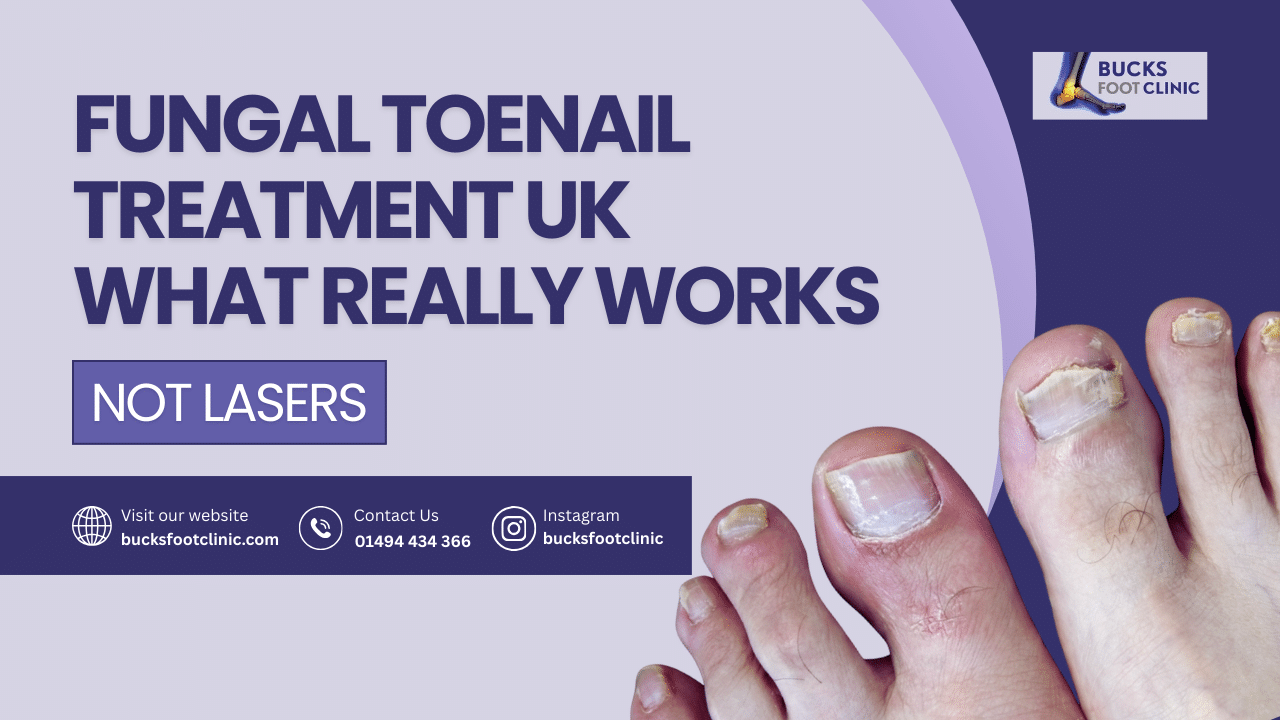
Fungal nail infections typically develop gradually, which is why many people don’t seek treatment until the infection is well established. Early signs include a white or yellowish spot appearing under the tip of the nail. As the infection progresses, the nail becomes thickened, discoloured (yellow, brown, or greenish), brittle, and crumbly. The nail may change shape, become distorted, or lift away from the nail bed. In some cases, a foul odour develops. The infection can spread to other toenails and even to the skin of your feet.
It’s worth noting that not every thick or discoloured nail is fungal. Trauma, psoriasis, and ageing can cause similar changes. An accurate diagnosis, ideally confirmed through laboratory testing, is important before starting any treatment.
Why Over the Counter Treatments Rarely Work
The fundamental challenge with fungal nail treatment is penetration. The nail plate is a dense, hard structure designed to protect the nail bed beneath it. Most topical antifungal products (paints, lacquers, and solutions) struggle to penetrate through the full thickness of an infected nail, particularly if the infection has been present for some time and the nail has thickened significantly.
Pharmacy antifungal paints like amorolfine (Curanail/Loceryl) can work for mild, superficial infections that affect less than half the nail. For anything more extensive, the cure rate is disappointingly low. Many patients apply these products religiously for months without seeing meaningful improvement.
Struggling with this problem? Call Bucks Foot Clinic on 01494 434366 or book online at bucksfootclinic.com for expert advice and treatment.
Why We Don’t Offer Laser Treatment for Fungal Nails
This is where we differ from some clinics, and we believe transparency matters. Laser treatment for fungal nails has been heavily marketed in recent years as a quick, painless solution. Whilst the concept is appealing, the evidence doesn’t support the claims.
Independent research as opposed to studies funded by laser manufacturers consistently shows that laser therapy for fungal nails has unsatisfactory success rates compared to established alternatives. Clinical trials have produced mixed results at best, and many patients who undergo laser treatment find the infection returns. At Bucks Foot Clinic, we believe in recommending treatments that are genuinely supported by evidence, even when a flashier option exists. Our reputation depends on results, not marketing.
How to Prevent Fungal Toenail Infections
- Keep your feet clean and dry fungi thrive in warm, moist environments
- Change socks daily and choose moisture-wicking materials over synthetic fabrics
- Rotate your shoes to allow them to dry out fully between wears (at least 24 hours)
- Wear breathable footwear made from natural materials where possible
- Use flip-flops in communal showers, changing rooms, and pool areas
- Treat athlete’s foot promptly the same fungi that cause skin infections can spread to the nails
- Don’t share nail clippers, files, or towels
- Keep nails trimmed short and filed smooth to reduce areas where fungi can accumulate
- If you visit nail salons, ensure instruments are properly sterilised between clients
Why Professional Treatment Makes the Difference
- Laboratory diagnosis confirms the exact type of fungal infection, ensuring the right treatment is selected from the start
- Professional debridement (reduction of the thickened nail) allows topical treatments to actually reach the infection rather than sitting uselessly on the surface
- A podiatrist can assess whether topical treatment alone is sufficient or whether oral antifungal medication (prescribed via your GP) would be more appropriate for your specific case
- Regular professional nail care during treatment keeps the infection managed and prevents it from worsening
- We set realistic expectations about timelines toenails grow slowly (roughly 1–2mm per month), so complete clearance takes time even with the most effective treatment
Embarrassed by your toenails? You don’t have to be. Contact Bucks Foot Clinic today on 01494 434366 to book your appointment, or visit bucksfootclinic.com. We have clinics in Amersham, Chesham, and Little Chalfont.
How Bucks Foot Clinic Treats Fungal Nails
Our approach is methodical and honest. We begin with a thorough assessment of the infection, including its extent, duration, and any contributing factors. Where appropriate, we arrange laboratory testing to confirm the diagnosis and identify the specific fungal organism involved.
Treatment typically involves regular professional debridement to reduce the thickness of the nail, combined with a targeted topical or oral antifungal regime. We monitor progress at each appointment and adjust the plan as needed. For patients who are self-conscious about the appearance of their nails during treatment, we offer cosmetic nail reconstruction to improve the nail’s appearance whilst the underlying infection is being treated.
We won’t promise overnight results, because that wouldn’t be honest. What we will promise is an evidence-based approach with the highest probability of genuine, lasting clearance.